πŸ€–AI Text-to-Speech

Run TTS on Kick with KickBot: 3,000+ AI voices for chat to use, custom voice clones, AI moderation, on-screen captions, and an OBS browser source.

KickBot TTS lets viewers send messages that play back as voice audio over your stream. The dashboard splits into four tabs: Commands (the voices and triggers), Voice Library (the catalogue), Moderation (filters) and Settings (playback rules and the OBS widget URL).

This guide assumes you have a KickBot account with your Kick channel connected.

Open kickbot.com/dashboard/tts/commands or click TTS Commands in the left sidebar.

TTS Commands

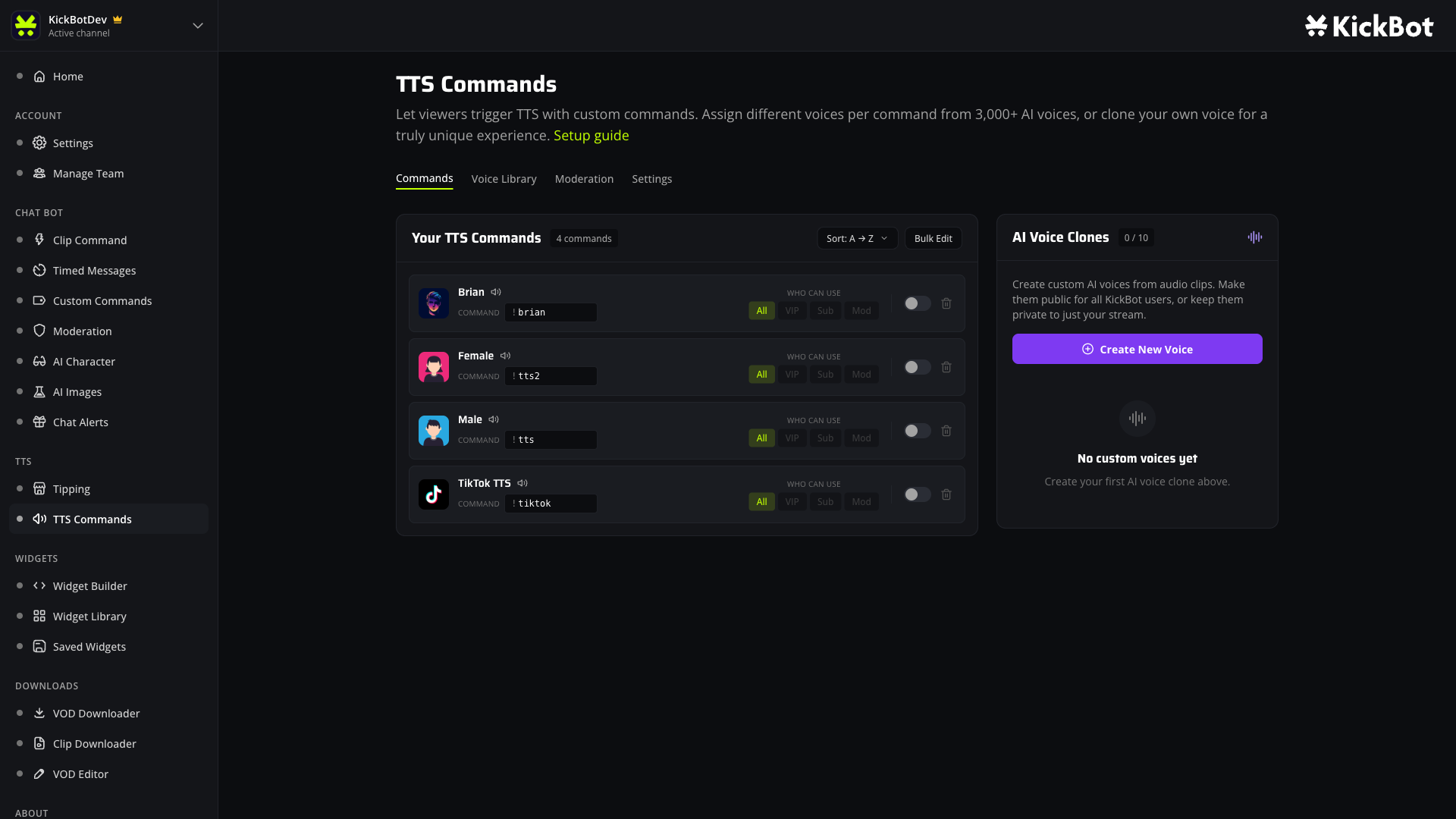
Each command is a chat trigger like !brian or !tts that reads a viewer's message through the TTS browser source. Every account starts with four free voices: Brian, Female, Male, and TikTok TTS. KickBot Premium unlocks the full library plus 10 voice clone slots.

KickBot TTS commands tab on Kick showing four default voices and the AI Voice Clones panel
The Commands tab. Saved voices on the left, the AI Voice Clones panel on the right.
Each card has the voice name and icon, the chat command box, the Who Can Use row, an enable toggle, a speaker icon to preview the voice, and a delete button.

  • Command name. Click the box next to the ! to rename the trigger. Letters and numbers only, up to 15 characters. Press Enter or click away to save.

  • Who can use. Tap All, VIP, Sub, or Mod to control who can run the command. All is the default and overrides the others. With All off, you can combine VIP, Sub, and Mod.

  • Enable toggle. The switch on the right turns the command on or off without removing it from the list.

  • Sort menu. Order the list by enabled first, disabled first, or alphabetical. Your sort preference is remembered.

  • Bulk Edit. Tick several voices, pick a permission set, then click Apply to push the change to all of them at once.

Changes save the moment you toggle a permission or click out of the command box. There is no separate Save button on this tab.

Voice Library

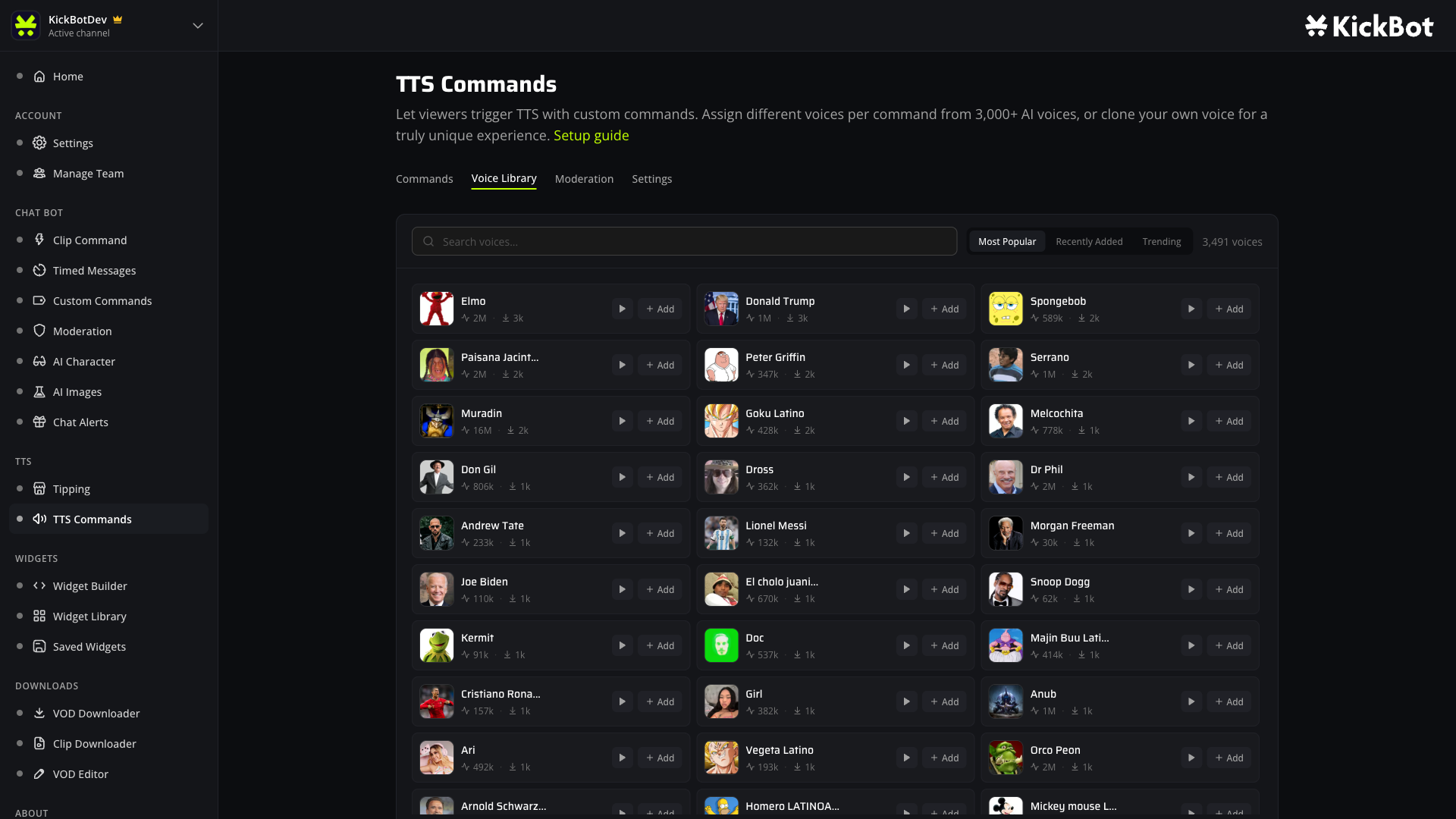
The library is the full catalogue of TTS voices on KickBot. The configured account currently sees 3,491 voices, sorted by Most Popular. You can also browse Recently Added or Trending, or search by name.

Voice Library tab showing thousands of KickBot TTS voices sorted by most popular with celebrity, character, and community voices
The Voice Library, sorted by most popular. Each row has a play button to preview the voice and an Add button to drop it into your commands list.
Click Add next to any voice to push it into your TTS commands list. There is no cap on how many library voices you can keep on your channel. Library voices outside the four free defaults require Premium to enable.

Voice cloning

The AI Voice Clones panel on the Commands tab is where you build custom voices from audio you upload. Cloning is a Premium feature, with 10 clone slots per account by default.

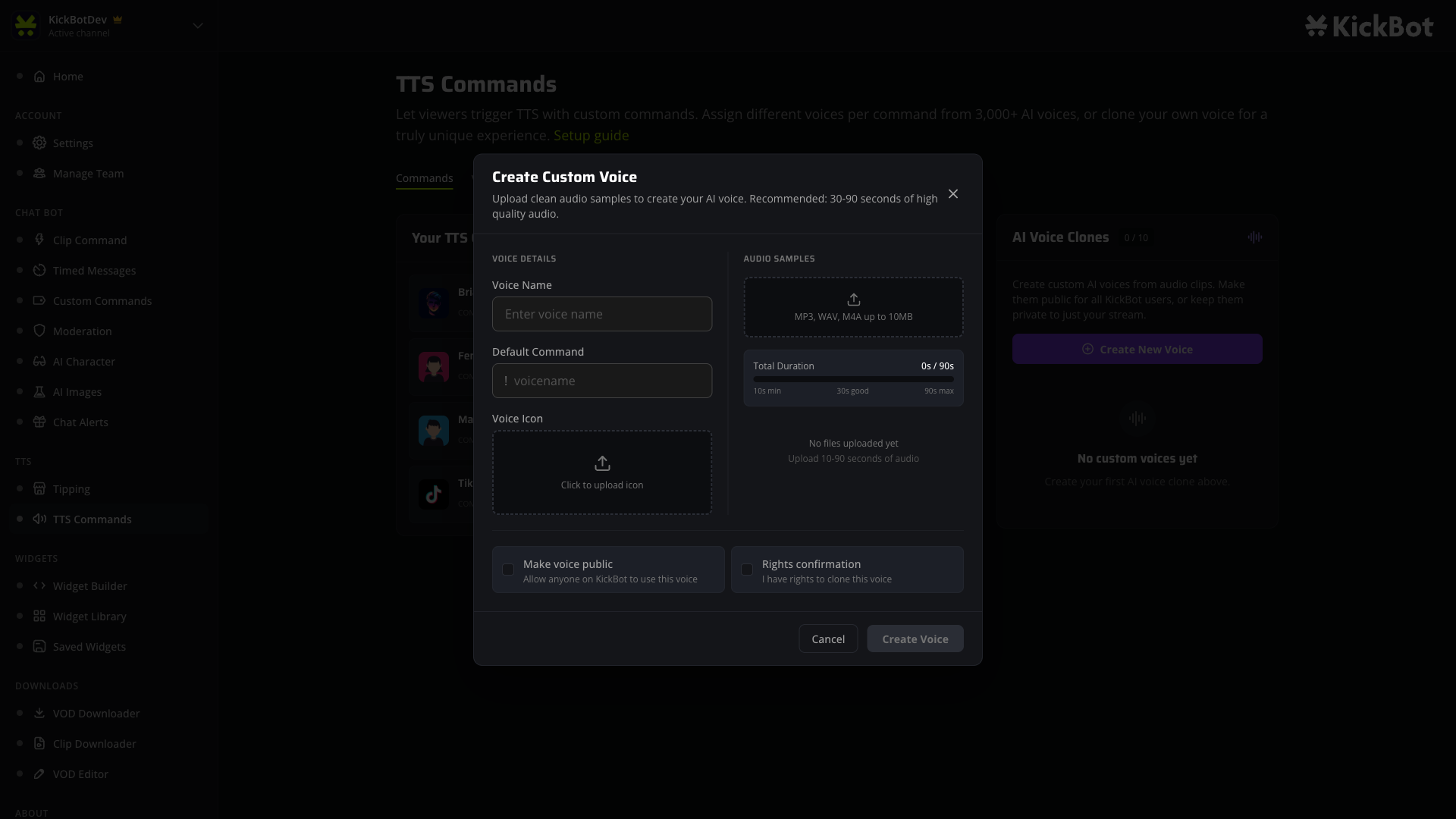
Create Custom Voice popup with Voice Name, Default Command, Voice Icon, Audio Samples uploader, Make voice public toggle, and Rights confirmation checkbox
The Create Custom Voice popup. Fill in the voice details, add clean audio samples, confirm rights, then click Create Voice.
Click Create New Voice in the AI Voice Clones panel to open the popup. You will need:

  • Voice name. What viewers see in your command list. Up to 20 characters.

  • Default command. The chat trigger, with no !. Up to 20 characters.

  • Voice icon. A square image. The popup includes a built-in cropper.

  • Audio samples. One to five clips totalling 10 to 90 seconds, with 30 seconds recommended. MP3, WAV, or M4A, up to 10MB per file. Clean speech from one person works best.

  • Make voice public (optional). Lets every KickBot user discover your clone in the Voice Library.

  • Rights confirmation. Required. You must have permission from the person whose voice you are cloning.

Training takes up to a minute. Keep the page open while it runs. Once finished, the voice shows up at the top of your command list.

Moderation

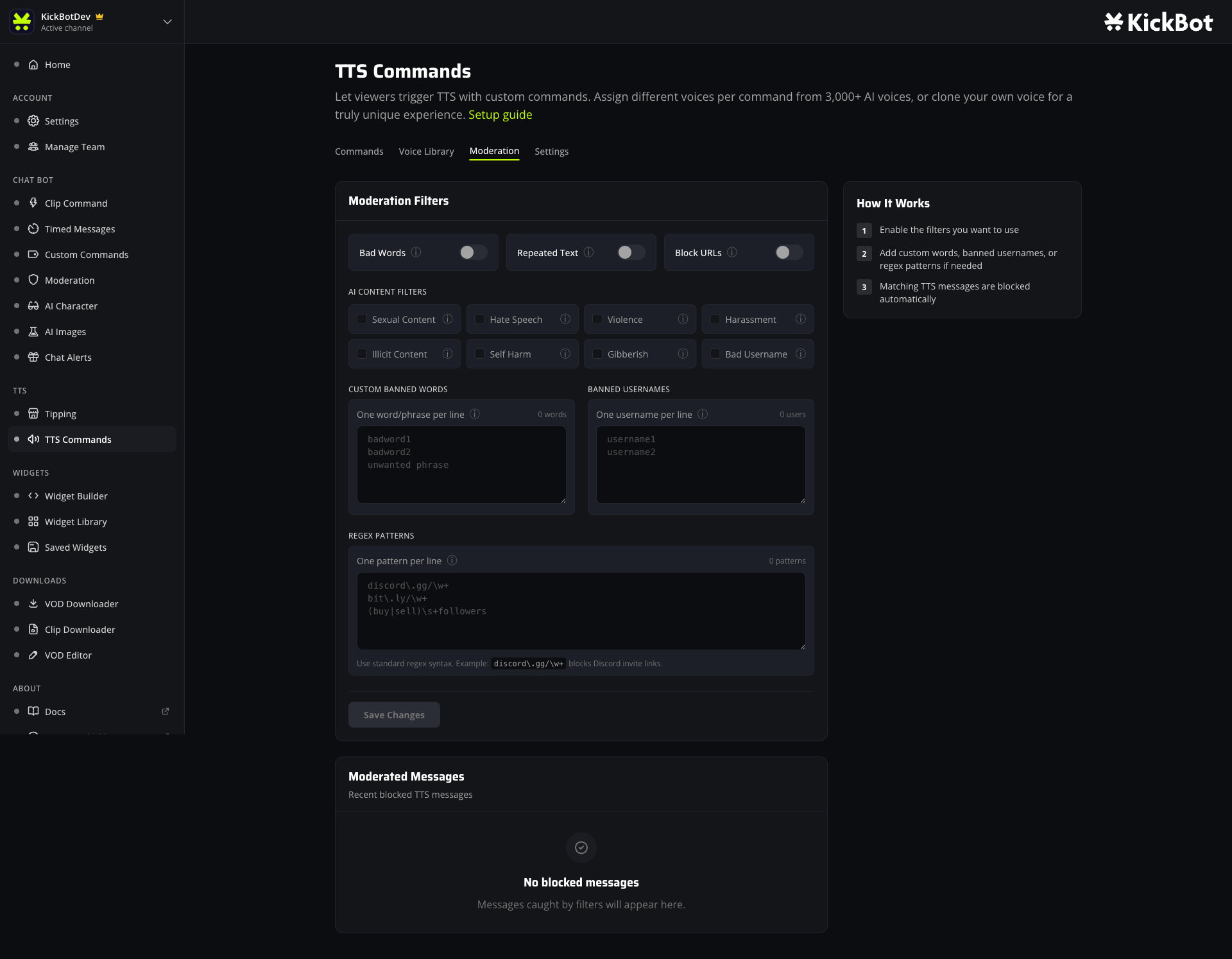
The Moderation tab filters TTS messages before they play. Three quick toggles cover the common cases, and a row of AI filters block messages by category. Below those, you can paste your own banned words, banned usernames, or regex patterns.

TTS Moderation tab with Bad Words, Repeated Text and Block URLs toggles, eight AI Content Filters, and custom banned words, usernames and regex inputs
The Moderation tab. Toggle filters at the top, paste custom rules below.
  • Bad Words. Filters common profanity and slurs.

  • Repeated Text. Blocks messages with excessive repeated characters or words.

  • Block URLs. Blocks any message containing a link.

  • AI Content Filters. Eight categories powered by an AI classifier: Sexual Content, Hate Speech, Violence, Harassment, Illicit Content, Self Harm, Gibberish, Bad Username.

  • Custom Banned Words. One word or phrase per line. Case-insensitive.

  • Banned Usernames. One username per line. Blocks specific viewers from using TTS at all.

  • Regex Patterns. One pattern per line, standard regex syntax. Useful for blocking phone numbers, emails, or invite link formats.

The Moderated Messages panel below shows the most recent 50 blocked messages live, with the reason each was blocked.

Settings

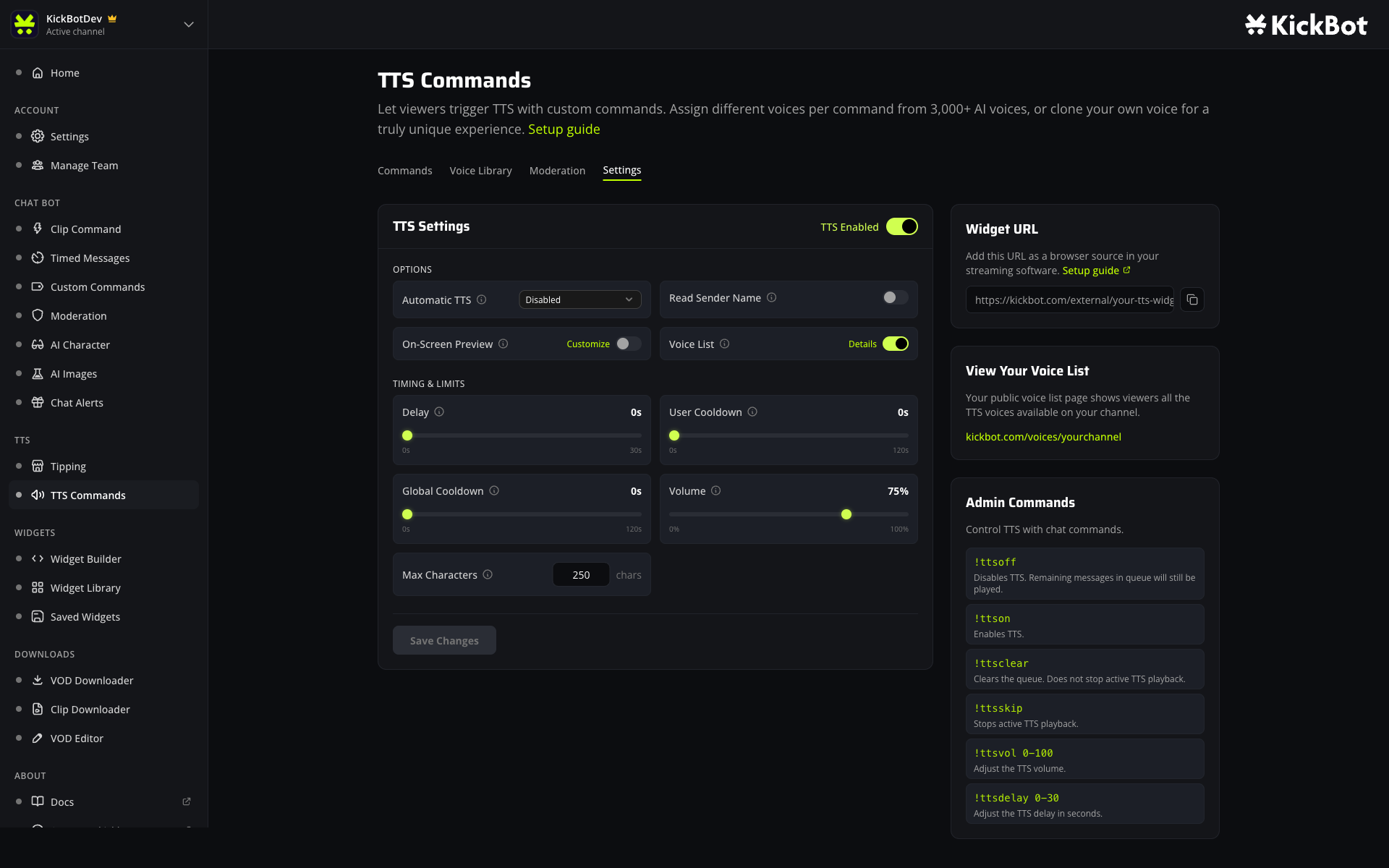
The Settings tab controls how TTS plays back, how loud, how often, and whether each message shows on screen. It also holds the widget URL you paste into OBS.

KickBot TTS settings page on Kick with playback options, timing limits, the widget URL panel and admin chat commands sidebar
TTS Settings. The widget URL on the right is what you paste into OBS.

Settings on this tab need a click on Save Changes to apply.

  • TTS Enabled. Master switch in the card header. Off means no TTS plays at all.

  • Automatic TTS. Reads every chat message through TTS using one of four built-in voices (Multilingual Male, Multilingual Female, English-only Male, English-only Female). Not affected by cooldowns.

  • Read Sender Name. Speaks the viewer's username before the message.

  • On-Screen Preview. Shows each TTS message as a caption on stream while it plays. Click Customize for a popup that lets you set position, animation, font size, text color, background opacity, and whether to show the sender or voice name.

  • Voice List. Turns on a public page at kickbot.com/voices/yourchannel that lists every enabled voice plus a leaderboard. Viewers can also pull it up with !voices in chat.

  • Delay. Adds a pause between TTS messages. Slider from 0 to 30 seconds.

  • User Cooldown. Minimum wait between TTS messages from the same viewer. 0 to 120 seconds.

  • Global Cooldown. Minimum wait between any TTS messages, applies to everyone. 0 to 120 seconds.

  • Volume. Master volume for all voices. 0 to 100 percent.

  • Max Characters. Caps how long a single TTS message can be. 0 to 300 characters.

Chat commands you can use while live

The right sidebar lists six commands that adjust TTS in real time without opening the dashboard. They can be run by you or any moderator.

  • !ttsoff Disables TTS. Messages already in the queue still play.

  • !ttson Re-enables TTS.

  • !ttsclear Empties the queue. Does not stop the message currently playing.

  • !ttsskip Skips the message currently playing.

  • !ttsvol 0-100 Sets the volume.

  • !ttsdelay 0-30 Sets the delay in seconds.

Add the OBS browser source

For TTS to play out of your stream, you need the widget loaded as a browser source in your streaming software.

  1. On the Settings tab, copy the URL under Widget URL (the format is https://kickbot.com/external/<your-id>/tts).

  2. In OBS Studio, click the + under Sources and pick Browser.

  3. Name the source (for example "KickBot TTS") and click OK.

  4. Paste the widget URL into the URL box.

  5. Tick Control audio via OBS.

  6. Click OK.

The browser source produces no visible output unless On-Screen Preview is on, so you will not see anything in your scene. Audio will route through the OBS audio mixer the next time TTS plays.

If you cannot hear TTS but the volume bar is moving

Audio monitoring is the usual culprit. In OBS:

  1. In the Audio Mixer, click the three dots next to the TTS source's volume slider and pick Advanced Audio Properties.

  2. Set Audio Monitoring for the TTS source to Monitor and Output.

  3. Open OBS Settings > Audio > Advanced and check the Monitoring Device is set to a device you can hear (your headphones or speakers).

Test it

With at least one command enabled and the OBS browser source running, type the trigger plus any text into your Kick chat:

A few seconds later you should hear the message read through your stream.

Troubleshooting

If TTS is not playing, work through these in order:

  • On the Settings tab, confirm TTS Enabled is on and click Save Changes if you toggled anything.

  • On the Commands tab, check the voice you are testing has its enable toggle on and the Who Can Use row matches the role you are testing from.

  • Check Max Characters on the Settings tab. If it is set to a very low number (say, 5), almost every chat message will be longer than the cap and get skipped. The default is 300.

  • Refresh the TTS browser source in OBS. Right-click the source, pick Properties, and click Refresh cache of current page.

  • If you used to hear TTS and suddenly cannot, this is almost always an OBS audio routing issue. See "If you cannot hear TTS but the volume bar is moving" above.

  • If a specific message is being blocked, check the Moderation tab's Moderated Messages panel. It shows the reason each blocked message tripped a filter.

FAQ

How do I set up TTS on Kick?

Connect your Kick channel to KickBot, open the Commands tab at kickbot.com/dashboard/tts/commands, and confirm at least one voice is enabled. On the Settings tab, copy the widget URL into a new browser source in OBS, then test with !brian hello chat in your Kick chat.

How do I send a TTS on Kick?

Type the command followed by your message, for example !brian hello chat. The default voices use !brian, !tts, !tts2, and !tiktok. You can rename any command on the Commands tab.

How many TTS voices does KickBot support?

Every channel starts with the four free voices. Premium unlocks the full Voice Library, which currently has more than 3,000 AI voices including celebrities, characters, and community-cloned voices, plus the ability to create up to 10 of your own clones.

Are there any cooldowns or character limits on TTS?

Yes, you set them. The Settings tab has a per-user cooldown (0 to 120 seconds), a global cooldown (0 to 120 seconds), a delay between messages (0 to 30 seconds), and a max message length (0 to 300 characters). Defaults are 0 cooldown and a 300 character cap.

How do I clone a voice on KickBot?

Open kickbot.com/dashboard/tts/commands, click Create New Voice in the AI Voice Clones panel, fill in the name and command, upload 10 to 90 seconds of clean audio of one person, and confirm you have rights to clone the voice. Training takes up to a minute. Voice cloning requires Premium.

Will TTS slow down my computer?

No. KickBot generates the audio on our servers and streams it to the OBS browser source, so the workload stays off your machine.

Need a hand

If a voice is not playing, a clone is not training, or a moderation rule is not catching what it should, message the team at [email protected] or drop into the #support channel on the KickBot Discord.

Last updated

Was this helpful?